I spend hours every day on Reddit, GitHub, and Stack Overflow. These three sites are the most link-dense places on the internet. A single Reddit thread can have 50 external links. A GitHub issue can reference 10 PRs, commits, and docs. A Stack Overflow answer links to three documentation pages and two related questions.
I used to end every research session with 30 to 40 tabs open. Now I end with two. Here is the exact setup.
The 2-Tab Setup
Tab 1 is the platform I am currently on. If I am researching on Reddit, that tab is Reddit. If I am debugging with Stack Overflow, that tab is Stack Overflow. If I am reviewing code on GitHub, that tab is GitHub.
Tab 2 is my workspace. My code editor, my notes document, my draft, or my dashboard. This is where I apply what I learn. This tab never changes during the session.
Every external link I encounter gets one of three treatments. I decide in under two seconds:
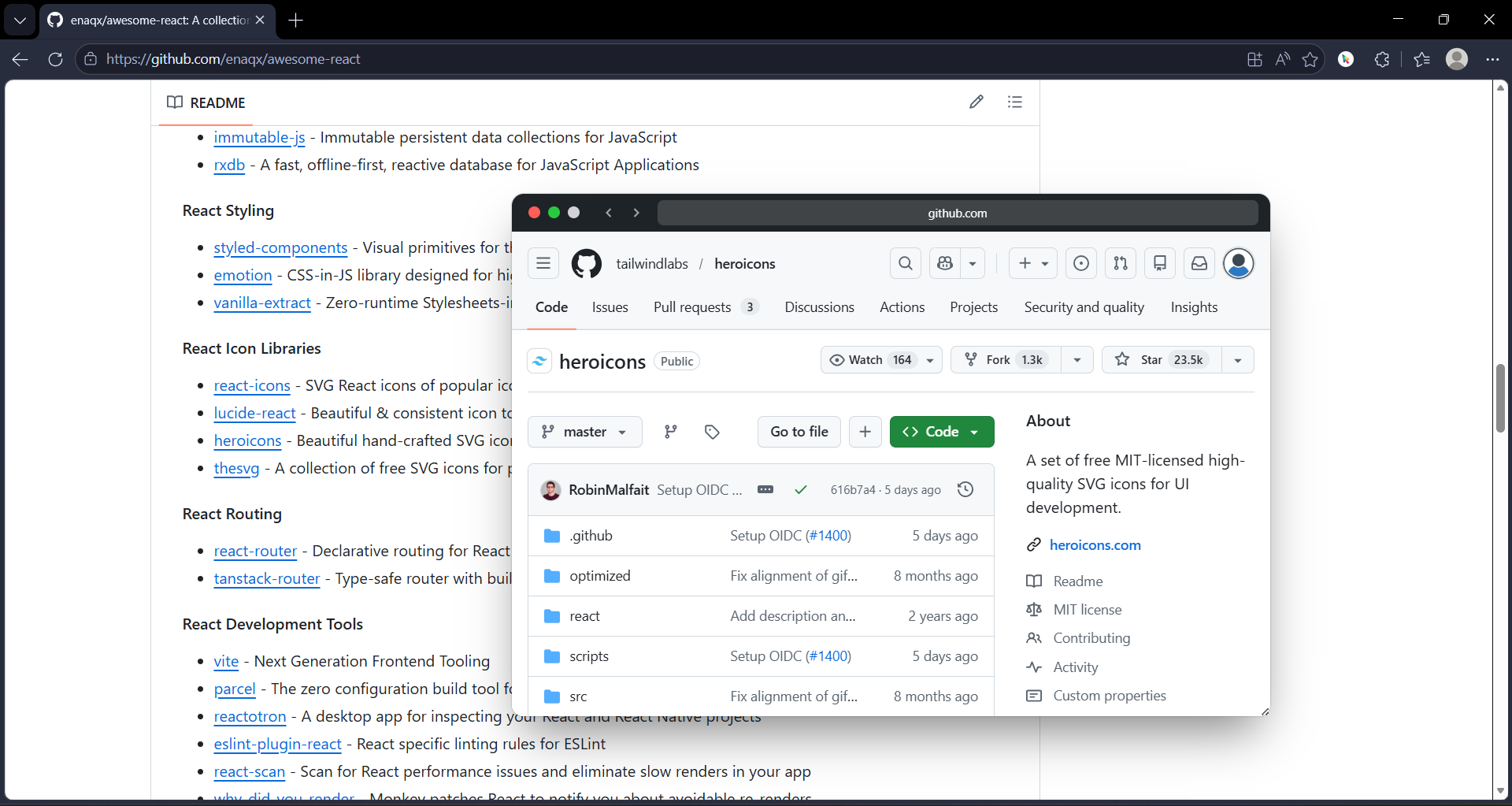
- Preview it: I need to check it now but will not work in it. This is 80% of links. I Shift-hover with GoPeek. The preview opens. I read it. I close it. No tab.
- Sidebar it: I need to reference it while I work. This is 15% of links. I drag the preview to sidebar mode. It sits on the right side of my screen while I type or code on the left. Still no new tab.
- Bookmark it: I need it later but not now. This is 5% of links. I hit Ctrl+D and move on. It does not become a tab.
Reddit: The Front Page of Tab Sprawl
Reddit is the worst offender. Every comment thread is a nest of external links. Someone asks for sources. Someone posts a dataset. Someone links a tool. Someone references a paper. The instinct is to open every link to verify it. That is how you get 25 tabs from one thread.
My Reddit workflow is simple. I keep the thread open in Tab 1. When I see a link I want to check, I Shift-hover it. The preview opens. If the source is garbage, I close it immediately. If it is useful, I read what I need, then close it. If it is something I need to reference while writing a reply or taking notes, I drag it to sidebar mode.
The sidebar is key for AMA threads and r/AskScience posts. I keep the main thread on the left and the previewed source on the right. I can quote the source directly into my reply without switching tabs. When I am done, I close the sidebar. The thread never lost focus.
I also use GoPeek for image and video links. Reddit threads are full of Imgur links, tweet screenshots, and YouTube videos. I preview them to verify content before deciding if they are worth opening. Most are not.
Example: Researching a tool on r/webdev
Old way: Open the Reddit thread. Open the tool homepage. Open the GitHub repo. Open the documentation. Open the Hacker News discussion about it. Open a review blog. Six tabs. I forget what the original question was.
New way: Thread stays in Tab 1. I preview the tool homepage, the repo, the docs, and the HN thread. I close the ones that are irrelevant. I sidebar the docs while I check the repo README. Total tabs: 1. Total previews: 4. Total time: 3 minutes.
GitHub: Issues, PRs, and the README Trap
GitHub is a web of dependencies. Every issue links to PRs. Every PR links to commits. Every README links to related repos and documentation. A single debugging session can spawn 15 tabs without you noticing.
My GitHub workflow keeps the original issue or repo in Tab 1. My IDE or terminal is in Tab 2. When I need to check a linked PR, I preview it. When I need to verify a commit, I preview it. When I need to read the docs for a dependency, I preview it.
Sidebar mode is essential here. If I am debugging an issue and need to reference the documentation while I code, I drag the docs preview into sidebar mode. The docs stay visible on the right. My code stays on the left. I copy error messages from the terminal, check the docs in the sidebar, and fix the code. No tab switching. No context loss.
The README trap is real. Every repo links to 5 more repos. I preview each one. If it is relevant, I bookmark it. If it is not, I close it. I do not open tabs for dependencies I am not actively using.
Example: Triaging a bug report
Old way: Open the issue. Open the linked PR. Open the commit diff. Open the related issue. Open the documentation page referenced in the comments. Open the staging environment to verify. Seven tabs. I lose track of which one had the actual bug description.
New way: Issue stays in Tab 1. IDE in Tab 2. I preview the PR, the commit, and the related issue. I close the ones that are not relevant. I sidebar the docs. I preview the staging link. Total tabs: 2. I never lose the original issue.
Stack Overflow: The Answer Chain
Stack Overflow answers are full of links. The accepted answer links to documentation. The second answer links to a GitHub repo. The third answer links to a related question. The fourth answer links to a blog post. Every link is a potential tab.
My Stack Overflow workflow keeps the original question in Tab 1. My code editor or draft is in Tab 2. I read the answers. When I see a link, I preview it. If the docs explain the function I need, I sidebar them while I code. If the repo is a library I might use, I bookmark it. If the related question is just a distraction, I close it.
Multi-Peek is the killer feature here. When I am comparing solutions, I open three answer links side-by-side. I see the docs, the repo, and the blog post simultaneously. I pick the best solution. I close the other two. The original question never lost focus.
I also use previews for the "See Also" sidebar. Stack Overflow suggests related questions that are often more useful than the current one. I preview them instead of opening them. Most of the time, they are not relevant. When they are, I bookmark them. They never become tabs.
Example: Debugging a Python error
Old way: Open the Stack Overflow question. Open the docs link in the accepted answer. Open the GitHub issue linked in the second answer. Open the related question about a similar error. Open the tutorial linked in the comments. Five tabs. I spend 10 minutes managing tabs instead of fixing the bug.
New way: Question in Tab 1. IDE in Tab 2. I preview the docs and sidebar them. I preview the GitHub issue and close it. I preview the related question and close it. I fix the bug in 4 minutes. Total tabs: 2.
The Decision Tree
Here is exactly how I decide what to do with every link I see:
| What I Need | Action | Result |
|---|---|---|
| Quick verification (under 30 seconds) | Shift-hover preview | Read, close, no tab |
| Reference while working (2-10 minutes) | Sidebar mode | Visible alongside workspace, no tab |
| Compare multiple sources | Multi-Peek | 2-4 previews side-by-side, no tabs |
| Need it later today | Bubble minimize | Stays accessible, no tab bar clutter |
| Need it next week | Bookmark | Ctrl+D, no tab |
| Need to work inside it actively | Open tab | Becomes Tab 1 or Tab 2 |
The last row is the only one that creates a tab. And it only happens when the link itself becomes my primary workspace. That is rare.
The Numbers
I tracked a typical week of research across these three platforms. Here is the difference between my old workflow and my current one:
I used to close all my tabs in frustration at least twice a week. I have not done that in six months. The 2-tab setup removes the need for purges because there is nothing to purge.
What This Requires
This workflow requires two things: a preview tool and a habit change.
The tool is GoPeek. It handles the previews, the sidebar mode, the multi-peek, and the bubble minimize. It works on Reddit, GitHub, Stack Overflow, and every other site. It takes 30 seconds to install.
The habit change is harder. You have to stop treating links as destinations. Most links are not places you need to move into. They are facts you need to verify, references you need to check, or options you need to compare. You do not need a new tab for any of those. You need a glance.
The habit takes about three days to form. On day one, you will still middle-click out of muscle memory. On day two, you will catch yourself and use the preview instead. On day three, the preview becomes the default. After a week, opening a new tab feels excessive.
When I Break the Rule
I do not always stick to 2 tabs. Sometimes I need 3. If I am writing a long technical post, I might have Reddit in Tab 1, my draft in Tab 2, and a specific source document in Tab 3 that I am actively quoting from. That is fine. The goal is not religious adherence to the number 2. The goal is preventing the number 20.
The 2-tab rule is a default, not a law. If a third tab is genuinely your primary workspace, open it. But ask yourself first: do I need to work in this page, or do I just need to read it? If the answer is "read it," use a preview. If the answer is "work in it," use a tab.
The Bottom Line
Reddit, GitHub, and Stack Overflow are essential tools for developers, researchers, and writers. But they are designed to create tabs. Every link is an invitation to open a new page. The platforms do not care if you end up with 40 tabs. They are not optimized for your focus. You have to optimize it yourself.
My optimization is simple. Two tabs. One for the platform. One for my work. Everything else is a preview. The result is a cleaner browser, faster research, and no more Friday tab purges.