Research should take an hour. It takes three. Not because the information is hard to find. Because the process of finding it is broken.
You start with one question. You open a search result. It mentions three related concepts. You open all three. Those three link to five sources each. You open the promising ones. Now you have 8 tabs. You have not answered the original question. You have 8 new questions.
This happens because your browser treats every link as a commitment. It opens a new tab. It loads a new process. It demands a new slice of your attention. And every time you switch back to your original page, you have lost the thread.
Here is why research takes 3x longer than it should — and how to stop it.
How Research Turns Into Tab Sprawl
Research is not linear. Every source links to more sources. A Wikipedia article has 50 to 200 links. A research paper has 30 to 100 citations. A news article has 5 to 10 source links. A Hacker News thread has 50 to 200 external links in the comments. You are not reading a page. You are traversing a network.
Browsers are built for linear browsing. You go to a page. You read it. You go back. But research does not work like that. You need to check a source, verify a claim, compare two studies, and return to the original — all within minutes. The browser handles this by opening tabs. And tabs are the wrong tool for networked thinking.
The 30-Minute Research Session: A Timeline
0:00 — Search for "climate policy 2026." Open the first result.
0:03 — The article mentions a UN report. You open it. 2 tabs.
0:05 — The UN report links to a data set. You open it. 3 tabs.
0:08 — The data set links to a methodology paper. You open it. 4 tabs.
0:12 — The methodology paper cites 8 sources. You open 3. 7 tabs.
0:18 — One of those sources is a paywalled paper. You open Sci-Hub. 8 tabs.
0:22 — The Sci-Hub page has a comment linking to a related blog post. You open it. 9 tabs.
0:26 — You try to return to the original article. You cannot find it. You have 9 tabs and you have lost the thread.
0:30 — You spend 5 minutes searching for the original article. You find it. You re-read the paragraph you were on. You have forgotten what you were trying to verify.
Result: 30 minutes elapsed. 9 tabs open. 0 answers found. You start over.
This happens often. The browser forces every source into the same container — a tab — and every tab competes for your attention.
Why Tabs Destroy Research Speed
Tabs hurt research in three specific ways. Each one multiplies the time cost.
1. Context Switching
Every time you switch tabs, your brain drops what it was thinking and loads something new. Research by Gloria Mark at UC Irvine shows that after a context switch, it takes an average of 23 minutes to return to deep focus. You do not lose 5 seconds switching tabs. You lose 23 minutes of productive thinking.
In a 30-minute research session, you might switch tabs 10 to 15 times. That is not 15 seconds of switching. That is 15 context switches, each leaving part of your attention on the previous tab. By the end of the session, your focus is scattered across 9 pages and concentrated on none of them.
2. Tab Hoarding
You open a tab because you "might need it later." You do not need it later. You forget it exists. But it stays open, consuming RAM, running background processes, and sitting in your tab bar as a visual distraction. Every tab you hoard is a claim on your working memory. Your brain tracks them subconsciously. That is why a crowded tab bar feels stressful even when you are not looking at it.
The hoarding also makes it hard to close tabs. You spent effort opening them. Closing them feels like admitting the time was wasted. So you keep them open. The tab bar fills with tabs you opened out of curiosity and never closed. And the pile grows.
3. The Search Tax
When you have 10 tabs open, finding the one you need is a search problem. You scan the tab bar. You read truncated titles. You squint at favicons. You hover over tabs to see previews. You open the wrong one. You close it. You try another. This is pure overhead. It is not research. It is tab management. And it can consume 20% to 30% of your total research time.
Why Tab Groups and Vertical Tabs Do Not Fix It
Some people try to solve this with tab groups or vertical tabs. They are better than a flat tab bar, but they do not solve the root problem. They just organize the chaos.
Tab groups let you color-code your 20 tabs into 4 groups. You still have 20 tabs. You still context-switch 20 times. You still consume the same RAM. The only difference is that now you spend additional time deciding which group a tab belongs in. That is overhead, not efficiency.
Vertical tabs let you see more titles at once. They scale better than horizontal tabs. But they still treat every link as a tab. They still consume RAM. They still require context switches. And because the sidebar can hold 50 tabs without looking cluttered, they actually encourage deeper hoarding. You stop feeling the pain of having too many tabs open. But your computer still feels it.
Neither tool addresses the core issue: you are opening tabs for sources you only need to glance at. A tab is a commitment. Research requires checking many sources to find the few that matter. Opening 10 tabs for 10 quick checks is absurd. It is like hiring 10 people for full-time jobs just to interview them.
The Fix: Preview, Do Not Commit
The solution is not better tab management. It is fewer tabs. Specifically, it is treating research sources as previews instead of destinations.
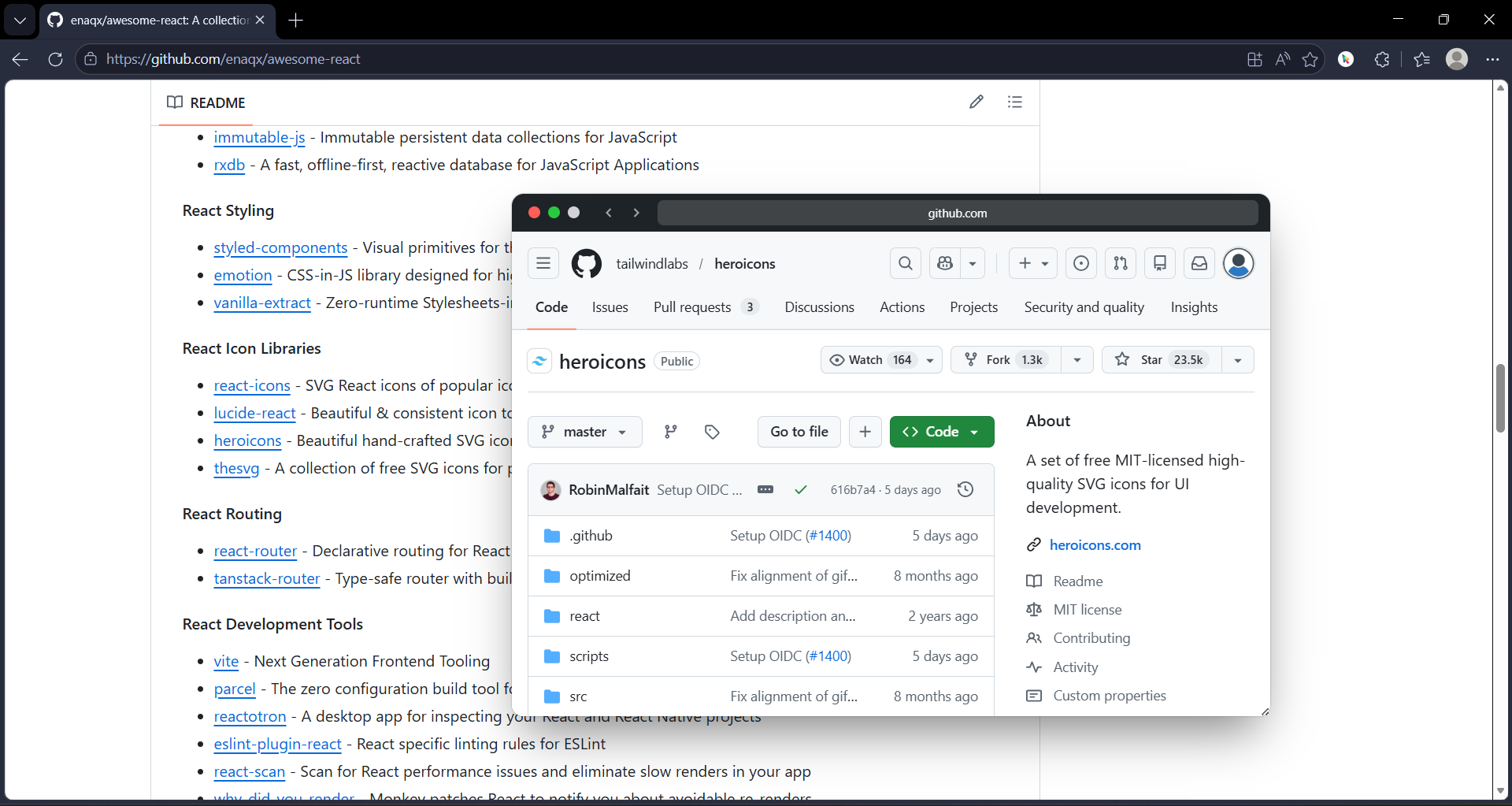
Here is the workflow. You are reading an article. You see a link to a source. You hold Shift and hover it with GoPeek. A preview window opens. You read the abstract, check the data, or verify the claim. You close the preview. You never opened a tab. You never lost your place. You never context-switched. The source was checked, evaluated, and dismissed — or bookmarked for later — in under 30 seconds.
This changes the math entirely. A research session that previously required 15 tabs now requires 2 or 3. The original article stays open. Your notes document stays open. Everything else is a preview. Your RAM stays under 1GB. Your focus stays on the original question. And your research speed triples.
The Same 30-Minute Session, With GoPeek
0:00 — Search for "climate policy 2026." Open the first result. 1 tab.
0:03 — The article mentions a UN report. You Shift-hover the link. Preview. Read the summary. Close. 1 tab.
0:06 — The report links to a data set. You Shift-hover. Preview. Check the methodology note. Close. 1 tab.
0:09 — The data set links to a methodology paper. You Shift-hover. Preview. Not relevant. Close. 1 tab.
0:12 — The methodology paper cites 8 sources. You Shift-hover 3 of them. One is relevant. You bookmark it. The other two are not. Close both. 1 tab.
0:18 — You find a paywalled paper. You Shift-hover the Sci-Hub link. Preview. Download the PDF. Close. 1 tab.
0:22 — You see a related blog post in the comments. You Shift-hover. Preview. Useful perspective. You bookmark it. Close. 1 tab.
0:25 — You return to the original article. You never left it. You know exactly what you were verifying. You insert the citation. You move to the next paragraph.
Result: 25 minutes elapsed. 1 tab open. 2 bookmarks saved. 8 sources checked. 1 citation inserted. You are done with the section.
Sidebar Mode for Deep Comparison
Sometimes you need two sources side by side. A preview window is not enough. You need to read one while writing about it in another. For this, GoPeek has sidebar mode.
Drag a preview to the edge of your screen. It snaps into a split-screen panel. Your original page stays on the left. The source stays on the right. You can scroll both independently. You can copy from the source and paste into your notes. You can click links inside the source and navigate without ever leaving your workspace.
This is not two tabs. It is one tab and one panel. The panel closes when you are done. It does not appear in your tab bar. It does not consume a full process. And it does not create a context switch because your eyes never fully leave the original page.
Multi-Peek for Comparing Multiple Sources
Some research tasks require comparing multiple sources simultaneously. Market research, literature reviews, product comparisons — you need to see 3 or 4 pages at once.
GoPeek Multi-Peek opens multiple preview windows side by side. You can compare 3 studies, 4 product pages, or 5 news sources in one view. No Alt-Tabbing. No tab bar scrolling. No losing your place. You see everything. You decide. You close them all.
This is impossible with tabs without creating a mess. With GoPeek, it is a single workflow.
Head-to-Head: Tab-Based Research vs. Preview-Based Research
| Metric | Tab-Based Research | GoPeek Research |
|---|---|---|
| Tabs created per session | 10 to 30 | 1 to 3 |
| Context switches | 15 to 25 per hour | 0 to 2 per hour |
| Focus recovery time | 23 minutes per switch | None — never leave your page |
| RAM usage | 3 to 8GB | Under 1GB |
| Tab management time | 20% to 30% of session | Zero |
| Sources evaluated per hour | 8 to 12 | 25 to 40 |
| Lost threads per session | 2 to 4 | Zero |
| End-of-session cleanup | Close 20 tabs, feel guilty | Close 1 to 3 tabs, done in 10 seconds |
Who This Helps Most
The preview-based workflow is not for everyone. It is for people who research as part of their job.
- Students writing papers. You need to check 20 sources to cite 5. Preview 20. Bookmark 5. Write without interruption.
- Journalists fact-checking. Every claim needs a source. Every source needs verification. Preview the source, verify the claim, insert the citation. No tab bar growth.
- Developers reading docs. One function signature requires checking 3 documentation pages. Preview all 3. Find the parameter. Close all 3. Keep coding.
- Analysts comparing data. 3 reports, 5 dashboards, 2 news sources. Multi-Peek them all. Decide in one view.
- Writers researching topics. Every paragraph needs a source. Preview the source. Extract the fact. Close it. The writing flow never breaks.
If your work involves reading external information while producing original work, tabs slow you down. Previews speed you up.
The Bottom Line
Research is slow because the tool is wrong. Browsers were designed for reading one page at a time. Research requires checking many pages without committing to any of them. The mismatch creates friction. The friction creates delay. The delay creates the 3x multiplier.
You do not need more discipline. You do not need better tab groups. You do not need vertical tabs or session managers or read-later apps. You need a tool that lets you check sources without opening them. A tool that keeps your original page in focus while you verify claims in previews. A tool that closes the preview when you are done and leaves no trace.
Use GoPeek for the quick checks. Use bookmarks for the keepers. Use tabs only for the pages you are actively working inside. Your research speed will triple. Your focus will sharpen. And your tab bar will finally reflect the simplicity of your actual task: one question, one page, one answer at a time.