

I will be honest: I was a tab groups evangelist.
When Chrome rolled out tab groups in 2020, I was the first person in my team to color-code everything. Work tabs in blue. Research in green. Entertainment in red. I had nested groups, labeled groups, collapsed groups. I told everyone it "changed my workflow." I wrote Slack messages about it. I genuinely believed I had hacked my productivity.
Then one day, about a year in, I looked at my browser and counted: 47 tabs open. In six different groups. And I had not actually finished a single task that morning.
That was the moment I realized the truth: tab groups had not made me more productive. They had just made my procrastination look organized.
The Year of Tab Groups: What Actually Happened
Let me walk you through a typical day during my tab group era.
I would start with a single task: write a product spec. I would open Google Docs. Blue group. Then I would need to reference a competitor's feature — so I would open their site. Green group. Then I would see a link to a related article in their footer. Green group. Then I would remember I needed to check Slack. Red group. Then someone would share a funny tweet. Red group. Then I would need to look up a stat for the spec. Green group. Then I would get distracted by a Hacker News thread. Yellow group, because I made a new one for "reading."
By 11 AM, I had 23 tabs in 5 groups. I had switched contexts at least 15 times. And the spec? Still blank.
Here is what I told myself: "At least they are organized." But organized chaos is still chaos. Every tab switch was still a context switch. Every new tab was still a new process consuming RAM. Every color-coded group was still a visual distraction pulling my attention away from the one thing I was supposed to be doing.
The Three Lies Tab Groups Tell You
After a year of this, I started noticing the patterns. Tab groups sell you three promises. All three are lies.
Lie #1: "You Are Organized"
No, you are not. You have 40 tabs in 6 color-coded folders. That is not organization — that is hoarding with a UI. Real organization means having what you need, when you need it, and nothing else. Tab groups give you the illusion of control while your RAM melts and your focus fractures.
Lie #2: "You Will Come Back to These"
You will not. I audited my tab groups after six months. Of the 31 tabs I had "saved for later" in various groups, I had returned to exactly three. The rest were digital graveyards — articles I would never read, docs I would never reference, pages I had already forgotten why I opened. Tab groups became a guilt-free way to hoard tabs I did not need.
Lie #3: "Groups Reduce Context Switching"
This is the biggest lie of all. Context switching is not caused by unorganized tabs. It is caused by too many tabs. Whether your 20 tabs are in one flat row or four color-coded groups, your brain still has to load and unload mental models every time you switch. The groups do not reduce the cognitive cost. They just make you feel better about paying it.
The Breaking Point
My breaking point came during a research sprint. I was writing a deep-dive article and needed to cross-reference about 10 sources. I opened them all, grouped them in green, and started writing.
Two hours later, I had written 200 words. I had checked Twitter four times, answered three Slack messages, and reorganized my tab groups twice because "the colors did not feel right." I had not finished the article. I had not even finished the outline.
I closed every tab. All 34 of them. I turned off tab groups entirely. And I asked myself a simple question: What if I just stopped opening tabs in the first place?
What I Use Instead: The No-Tab Workflow
That question led me to link previews. Not the read-only kind. The real kind — live, interactive, persistent mini-browser windows that let you actually work without ever creating a tab.
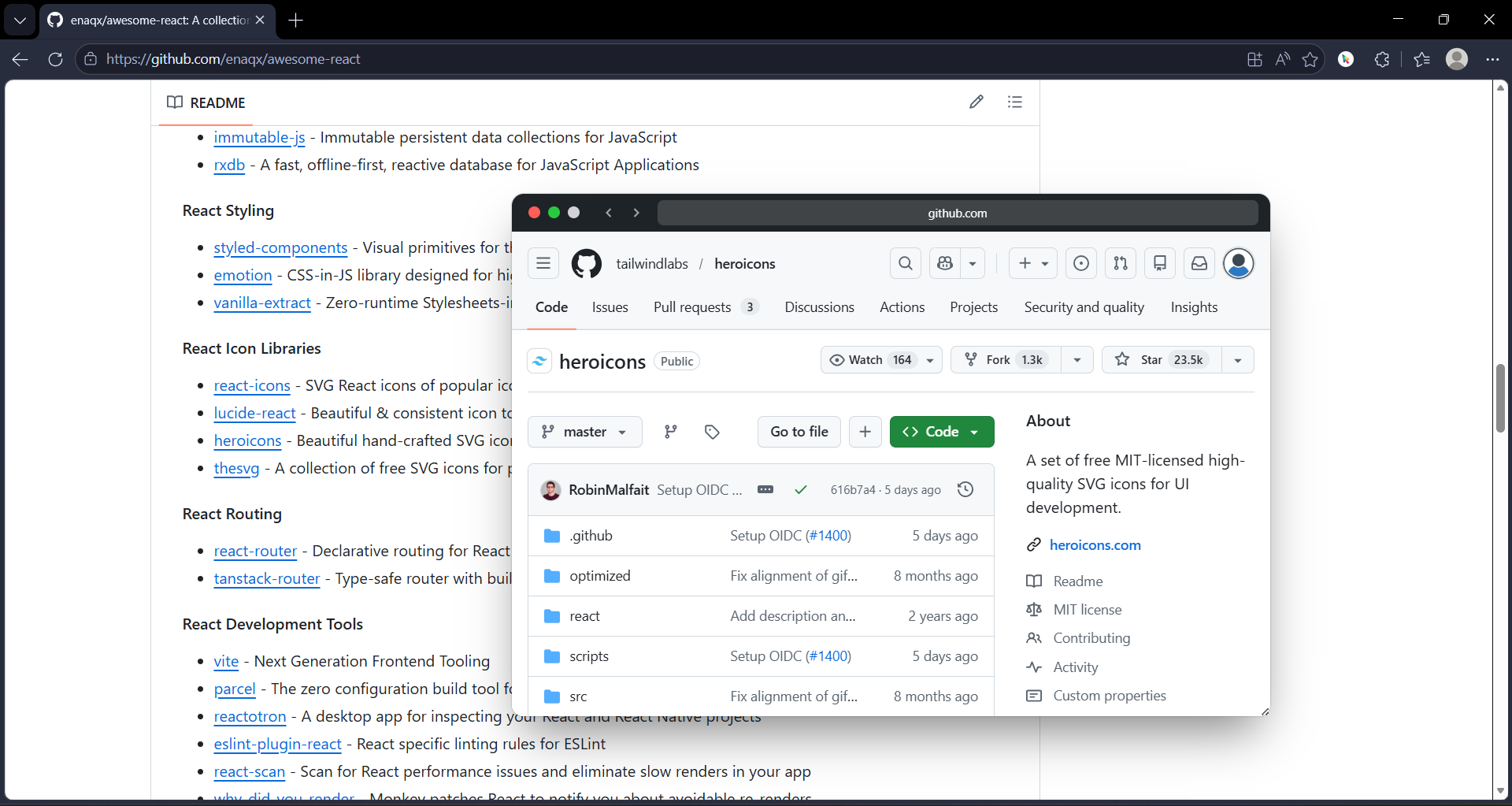
Here is what my workflow looks like now with GoPeek:
The Old Way (Tab Groups)
See a link → open new tab → load page → read → decide to keep → drag to group → forget it exists → repeat 20 times → wonder why your laptop fan sounds like a jet engine
The New Way (GoPeek)
See a link → hold Shift → hover → preview loads instantly → read, click, navigate inside the preview → done → move on → zero tabs created → zero context lost
The difference is not incremental. It is transformative.
With tab groups, every link was a commitment — a new tab, a new process, a new decision about where to file it. With GoPeek, every link is a glance. I hover, I see what I need, I move on. If I need to dig deeper, the preview is fully interactive. I can click links, fill forms, watch videos — all inside the preview window. I only open a real tab if I genuinely need to keep something permanently.
What GoPeek Does That Tab Groups Never Could
| What I Needed | Tab Groups | GoPeek |
|---|---|---|
| Check a link without losing focus | Open tab → group it → switch back → 23 min recovery | Shift + hover → glance → keep working |
| Compare multiple sources | Open 5 tabs → group them → switch between tabs → forget original context | Enable Multi-Peek → 3 live windows side-by-side → never leave your page |
| Save something for later | Keep tab open → add to group → tab stays in memory → guilt about closing it | Double-click header → bubble minimize → floats on screen → reopen anytime |
| Deep research session | 20 tabs in 4 groups → constant switching → mental fatigue | Sidebar mode → snap preview into split-screen → focus on one thing |
| RAM usage | Every tab loads full page → 20 tabs = 2-4GB RAM | Previews are lightweight → same work, fraction of the memory |
| Decision fatigue | High — managing tabs, groups, and context simultaneously | None — previews appear and disappear on demand |
The Features That Replaced My Tab Groups
Here is the specific GoPeek feature set that replaced every tab group habit I had:
1. Bubble Minimize (Replaced: "Save for Later" Groups)
I used to keep a red group called "Read Later." It had 40 tabs. I read maybe 3. Now, when I find something I want to revisit, I double-click the GoPeek header. It collapses into a floating bubble — a small circle with the site's favicon that sits on my screen. I can have five bubbles floating around, each a different reference, and my actual tab bar stays clean. When I need one, I click the bubble. It expands. I use it. I minimize it again. No tabs. No groups. No guilt.
2. Sidebar Mode (Replaced: Research Groups)
I used to have a green "Research" group with 15 tabs for every article I wrote. Now I drag a GoPeek window to the right edge of my screen. It snaps into sidebar mode — a resizable split-screen panel that pushes my main page to the left. I can write in Google Docs while referencing a source in the sidebar. No tab switching. No context loss. My eyes never leave the document I am writing.
3. Multi-Peak (Replaced: Comparison Groups)
I used to open three competitor tabs, group them, and switch between them to compare features. Now I enable Multi-Peak and open three GoPeek windows side by side. I can see all three sites simultaneously. I can interact with all three. I can copy text from one and paste it into another without a single tab switch. It is like having three monitors inside one browser window.
4. Search Selection (Replaced: "Quick Look-Up" Tabs)
I used to highlight text, open a new tab, search Google, find the answer, then close the tab. Now I highlight text, hold Shift, and a GoPeek window opens with the Google search results instantly. I find what I need, close the preview, and I am back to my original page in seconds. No new tab. No group needed. No 23-minute focus recovery.
5. Peek History (Replaced: Bookmark Groups)
I used to bookmark things into folders "just in case." Now I press Ctrl + Shift + P and see every link I have ever previewed. The last 100 peeks, with timestamps, favicons, and search. If I previewed it, I can find it again. No bookmarks needed. No folders to maintain. No "bookmark bankruptcy" every six months.
The Results After Three Months
I have been using the no-tab workflow for three months now. Here is what changed:
But the real metric is not numerical. It is how I feel when I work. With tab groups, I felt scattered — constantly aware of the growing pile of tabs I needed to "deal with." With GoPeek, I feel focused. One page. One task. Previews when I need them, gone when I do not. No piles. No groups. No guilt.
Who This Is (And Is Not) For
I am not saying tab groups are useless for everyone. They have a place. But that place is smaller than most people think.
Keep using tab groups if: You are a project manager with 5 persistent dashboards you reference occasionally, or a developer with 8 documentation tabs you check once an hour. You need organization, not elimination.
Stop using tab groups if: You are a researcher, writer, student, or anyone who clicks links constantly. If your "research group" grows by 5 tabs every hour. If your "read later" group has 50 tabs and you have read 3. If you spend more time managing tabs than using them.
The Bottom Line
Tab groups are a storage solution for a problem that should not exist. They ask: "How do we organize all these tabs?" The better question is: "Why do we have so many tabs in the first place?"
GoPeek answers the second question. It does not help you manage tabs. It helps you stop creating them. Every link becomes a glance, not a commitment. Every reference becomes a bubble, not a tab. Every research session becomes a split-screen, not a group.
I spent a year color-coding my chaos. Then I realized the chaos was the problem. If you are still using tab groups, ask yourself: Are you organizing your work, or organizing your procrastination?
If it is the latter, it might be time to stop grouping — and start peeking.