
Nobody asks why they have 47 tabs open until their laptop sounds like a jet engine. Then the question hits: Why did I open these instead of bookmarking them?
The answer is simple. Bookmarks feel like commitment. They feel like admitting you will never come back. So we invented tab groups — a way to "save" links without the psychological weight of a bookmark folder. We color-code them. We name them "Read Later" and "Important." Then we never read them.
Tab groups are not a saving system. They are a procrastination system dressed up as productivity. Let us settle this.
What Bookmarks Actually Do
Bookmarks are pointers. They cost nothing to create, nothing to store, and nothing to maintain. A bookmark is a URL and a title saved to a file. It does not consume RAM. It does not spawn a process. It does not load a favicon or execute JavaScript. It just sits there.
Bookmarks are also:
- Searchable. You can search your entire library in seconds across folders, titles, and URLs.
- Syncable. They sync reliably across devices. Your phone, laptop, and work desktop all have the same library. Tab groups? Chrome's sync is a coin flip.
- Permanent. A bookmark survives a browser crash, a restart, and an OS update. Tab groups vanish if you close the wrong window.
- Guilt-free. You can have 500 bookmarks in 20 folders and feel fine because they consume zero resources. They are not staring at you from the tab bar.
The problem with bookmarks is emotional, not technical. They feel like a graveyard. You bookmark something, never return, and eventually you have 3,000 bookmarks and a vague sense of failure. So people avoid bookmarking. They leave the tab open instead. An open tab feels like an open loop. A promise you have not broken yet.
What Tab Groups Actually Do
Tab groups are a desk pile. They are stacking papers on your desk and calling it a filing system. The red stack is "urgent." The blue stack is "research." It is still a pile. And piles do not scale.
Here is what tab groups actually accomplish:
- They consume RAM. Every tab in a group is a live process. A group of 20 tabs is 20 processes. On Chrome, that is 1-4GB of memory doing nothing while you eat lunch.
- They create anxiety. An open tab is an unfinished task. A tab group is a cluster of unfinished tasks. Your brain tracks them subconsciously. That is why a crowded tab bar stresses you out even if the tabs are "organized."
- They are not searchable. Try finding an article you saved in a tab group three days ago. You will scroll, squint at favicons, and open five wrong tabs. With bookmarks, you press Ctrl+Shift+O and type a keyword.
- They die easily. Close the window accidentally. Update your browser. Switch devices. Your tab groups are gone. Bookmarks do not die. They are backed up to your account automatically.
- They encourage hoarding. Tab groups give you permission to keep tabs open because they look tidy. "I will close this group later," you say. You do not. The group becomes permanent. Your browser slows down. The tabs remain unread.
The Library vs. The Desk Pile
Bookmarks are a library. You put a book on the shelf. It takes up a centimeter of space. You can find it later with the catalog. It does not scream at you while you work.
Tab groups are a pile of open books on your desk. Every book is open to a different page. They are stacked in colored piles. You tell yourself you will read them. But the piles grow. The desk shrinks. And eventually you cannot find the one book you actually need because it is buried under fourteen articles about "10 JavaScript Frameworks You Must Learn in 2026."
The difference is commitment vs. clutter. A bookmark is a commitment to future access. A tab group is clutter pretending to be a commitment. Clutter is not a system. It is mess with a label.
Why People Use Tab Groups Instead of Bookmarks
If bookmarks are objectively better, why do people use tab groups? Three reasons. All bad.
Reason 1: Laziness
Bookmarking takes two clicks. Tab grouping takes one drag. That is the entire reason. We are so allergic to two clicks that we would rather keep a live process running in the background for three days. It is leaving the oven on because you might want toast later.
Reason 2: The "I Will Read This Now" Delusion
When you open a tab, you genuinely intend to read it. You see a link, think "I need this for context," and open it. But you do not read it immediately. You tell yourself you will come back in a minute. You do not. The tab stays open because closing it feels like admitting defeat. So you drag it to a group. Now it is "saved." You have converted a temporary curiosity into permanent clutter.
Reason 3: Bookmarks Feel Like Failure
A bookmark says "I could not handle this right now, so I put it away." It is an admission of limited time. An open tab says "I am on top of this." Even if you have 40 open tabs and you are on top of none of them. The open tab preserves the illusion of productivity. The bookmark destroys it.
Tab Groups vs Bookmarks: The Comparison
| Feature | Tab Groups | Bookmarks |
|---|---|---|
| Memory usage | High — every tab is a live process | Zero — just a URL and title |
| Cross-device sync | Unreliable or missing | Instant and reliable |
| Survives crash | Sometimes — restore is a gamble | Always — backed up to cloud |
| Searchability | None — scroll and squint | Full-text search across all folders |
| Organization | Color-coded piles | Hierarchical folders, tags, separators |
| Psychological load | High — open loops everywhere | Low — archived and out of sight |
| Access speed | Instant — already loaded | One click to load |
| Scalability | Terrible — 50+ tabs = browser death | Unlimited — 10,000 bookmarks, no problem |
| Best for | Temporary sessions | Permanent reference |
The Only Time Tab Groups Make Sense
Tab groups are not useless. They are useless for saving links. They work for one thing: active, temporary sessions.
You are writing a report. You need 8 sources open right now. Not tomorrow. Right now. You group them so they do not get lost among your other tabs. You finish the report. You close the group. The session lasted 3 hours. That is what tab groups are for. They are a workspace, not an archive.
The moment a tab group lives longer than a single work session, it has become a failed bookmark. If you have a "Read Later" group older than 48 hours, you are not using tab groups. You are using a badly designed bookmark system that consumes 2GB of RAM.
The 48-Hour Rule
If a tab has been open for more than 48 hours and you have not interacted with it, close it or bookmark it. There is no third option. "Keeping it open in a group" is not a storage strategy. It is a hostage situation. Your browser is the hostage.
The Better Workflow: Three Buckets for Links
Here is how to handle links without the tab group/bookmark confusion.
Bucket 1: Read Now (GoPeek)
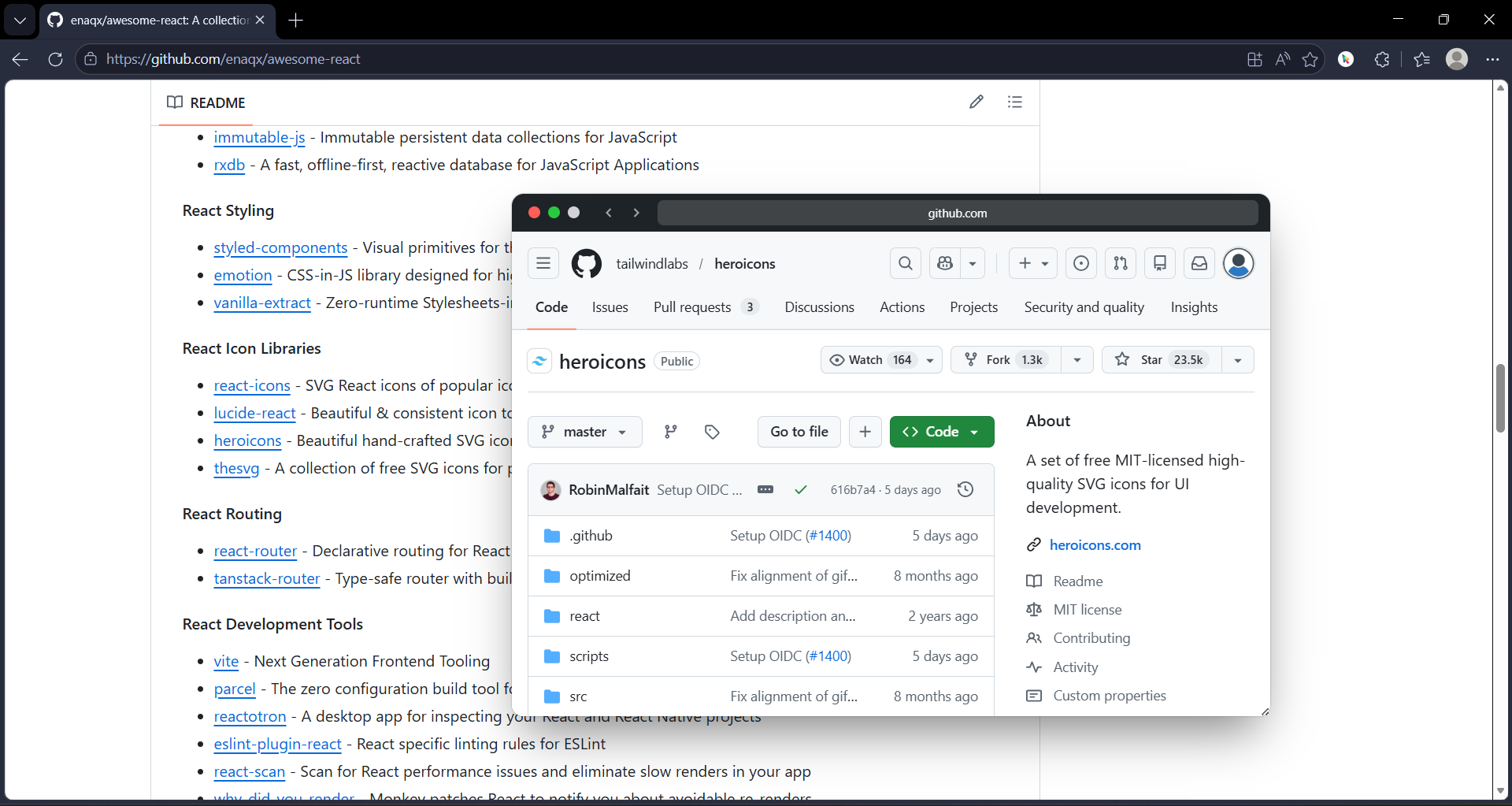
You see a link you need for context. You do not open it in a new tab. You hold Shift and hover it with GoPeek. A live preview opens. You read the relevant section. You close it. Zero tabs. Zero bookmarks. Zero context switches. This is for the 90% of links that only need a 30-second glance.
Bucket 2: Read Today (Tab Groups — Temporary)
You are in a focused session — writing, coding, researching — and you need 5-10 sources actively available. You open them. You group them. You finish the session. You close the entire group. If any tab survives the session, it failed. Move it to Bucket 3 or close it. Tab groups are a daily tool, not a weekly one.
Bucket 3: Save Forever (Bookmarks)
You find a resource you know you will need again. A documentation page. A research paper. A tutorial. You bookmark it immediately. You put it in the right folder. You forget about it. When you need it again, you search your bookmarks and it is there. It cost you zero RAM and zero anxiety.
Three buckets. GoPeek for previews. Tab groups for today's workspace. Bookmarks for the library. Most people skip the first bucket and try to use the second bucket for the third. That is why they have 40 tabs and a slow browser.
Why GoPeek Replaces the "Maybe Later" Tab
The biggest source of tab group bloat is the "maybe later" link. You are not sure if you need it. You open it "just in case" and stick it in a group. Now it is a permanent resident.
GoPeek removes that uncertainty. You hover the link. You see the page instantly. You make a decision in 10 seconds: relevant or not. If it is relevant, you bookmark it or keep it in a temporary group for today's session. If it is not, you close the preview and never think about it again. You do not need a tab group for "maybe" links. You need a preview tool for quick decisions.
Bookmarks are a library. Tab groups are a landfill with colored flags. GoPeek is the sorting machine that lets you decide what belongs in the library before it hits the ground.
The Bottom Line
Bookmarks save links. Tab groups save guilt. If you are using tab groups to store articles you will read someday, you are not organizing. You are hoarding. And your browser is paying the price.
Use bookmarks for permanent storage. They are searchable, syncable, permanent, and free. Use tab groups for temporary workspaces. They are useful for single-session focus. Use GoPeek for everything else — the quick checks, the maybe links, the "let me verify this" moments that do not deserve a tab, a group, or a bookmark.
The next time you open a link and think "I will put this in a tab group," ask yourself: Do I need this now, or do I need this forever? If now, preview it with GoPeek. If forever, bookmark it. If you are not sure, preview it first. Your tab bar will thank you. Your RAM will thank you. And your future self will find that link instantly in your bookmarks instead of hunting through a purple folder of forgotten tabs.